Design Authority: Maintaining Excellence Across Multiple Consultant Teams
Introduction
The Multi-Consultant Coordination Challenge
When a programme reaches the scale of multiple concurrent projects—each with its own architect, its own consultant team, and its own interpretation of the design vision—something fundamental shifts. The challenge is no longer about design quality on any single project. It becomes about maintaining consistent design quality across all of them, simultaneously, while each team operates under its own creative leadership, its own internal culture, and its own assumptions about what "good" looks like.
This is the domain of Design Authority, and it is substantively different from design management. A design manager focuses on a single project, coordinating disciplines within one team, ensuring that team delivers its scope to programme. Design Authority operates at the programme tier above: it defines the standards that every team must meet, the review mechanisms that validate compliance, and the decision protocols that enforce consistency when—inevitably—interpretations diverge.
The distinction matters because the failure mode is different. A single project with weak design management delivers a poor building. A programme without Design Authority delivers fourteen buildings that share a masterplan address but nothing else—no coherent identity, no consistent quality, no unified experience. The brand dilutes. The client's vision fragments. And the commercial value erodes, because inconsistency signals disorder to the market.
Over 27 years of practice, including the coordination of 30 architectural practices across 14 anchor assets within a single programme—governed by a 147-page design guideline developed specifically for that purpose—I have refined this challenge into a systematic, repeatable framework: a 3-Layer Design Authority Model that provides quality protection at programme scale.
Section 01
The Multi-Consultant Quality Problem
Consider the arithmetic of complexity. Thirty architectural practices, each with their own design philosophy, each staffed by teams who have never worked together, each interpreting a shared brief through the lens of their own firm's culture. Fourteen distinct assets—hospitality, cultural, residential, mixed-use—each with different functional requirements but all expected to read as parts of a single, coherent whole. Forty-plus consultant teams across engineering, landscape, interiors, and specialist disciplines, each reporting to a different architect but all accountable to the same programme vision.
The coordination challenge is not linear—it is exponential. Thirty architects do not create 30 times the complexity of one architect. They create a web of cross-references, interdependencies, and potential contradictions that multiplies with every additional team.
The common failure modes are predictable and well-documented in my experience:
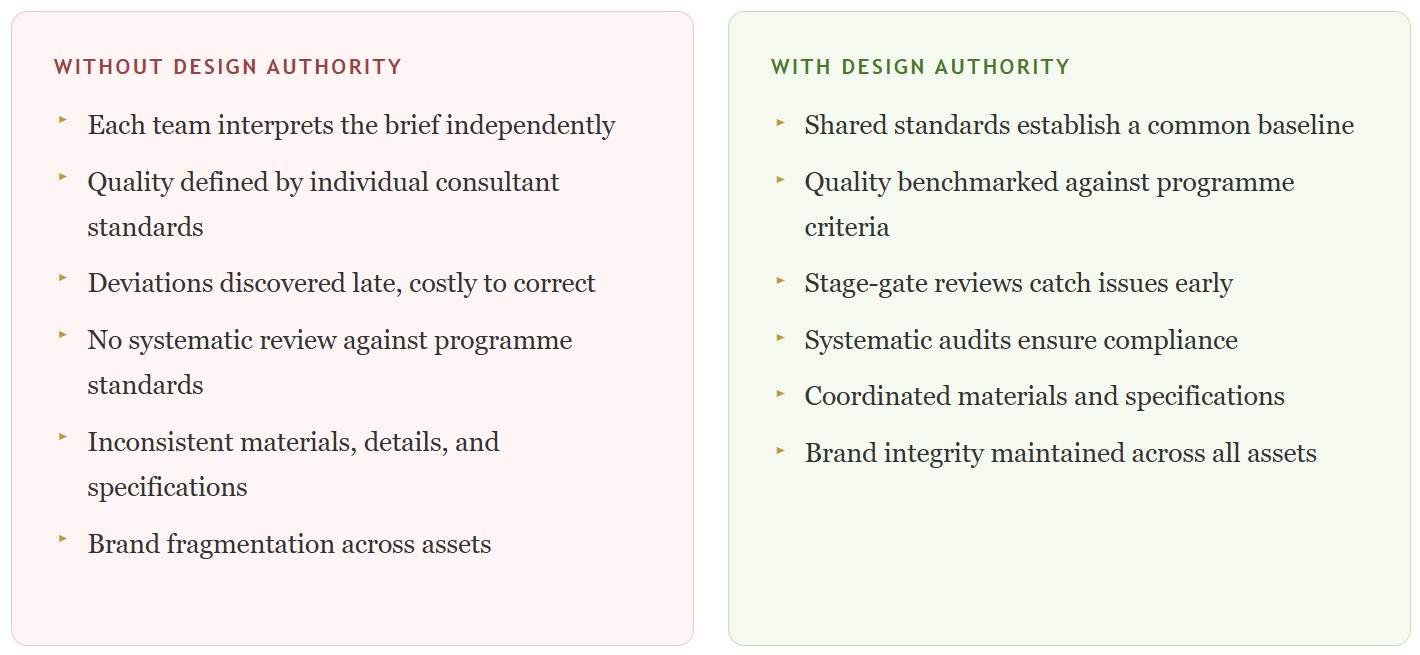
Quality drift: Standards progressively erode as consultants apply their own interpretation of "equivalent" materials, details, and spatial qualities
Consistency breakdown: Adjacent buildings designed by different architects develop fundamentally different design languages, creating visual and experiential dissonance
Autonomous deviation: Without clear approval protocols, consultants make material and specification changes unilaterally, assuming silence is consent
Coordination gaps: The space between the strategic vision (masterplan level) and consultant execution (building level) becomes a vacuum where quality decisions are made by default rather than by design
Commercial erosion: Inconsistent design quality across a programme directly impacts brand perception, market positioning, and ultimately asset values
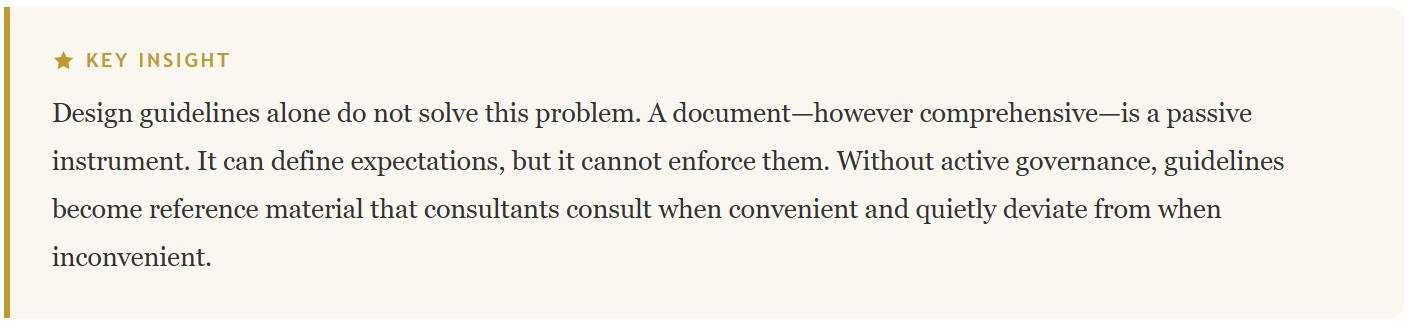
The root cause is structural, not behavioural. Most consultants are capable professionals doing their best work. The problem is that "best work" means something different to each firm, each design director, each project architect. Without a systematic framework that defines quality expectations, validates compliance, and enforces consistency, quality divergence is not a risk—it is an inevitability.
Section 02
The 3-Layer Design Authority Model
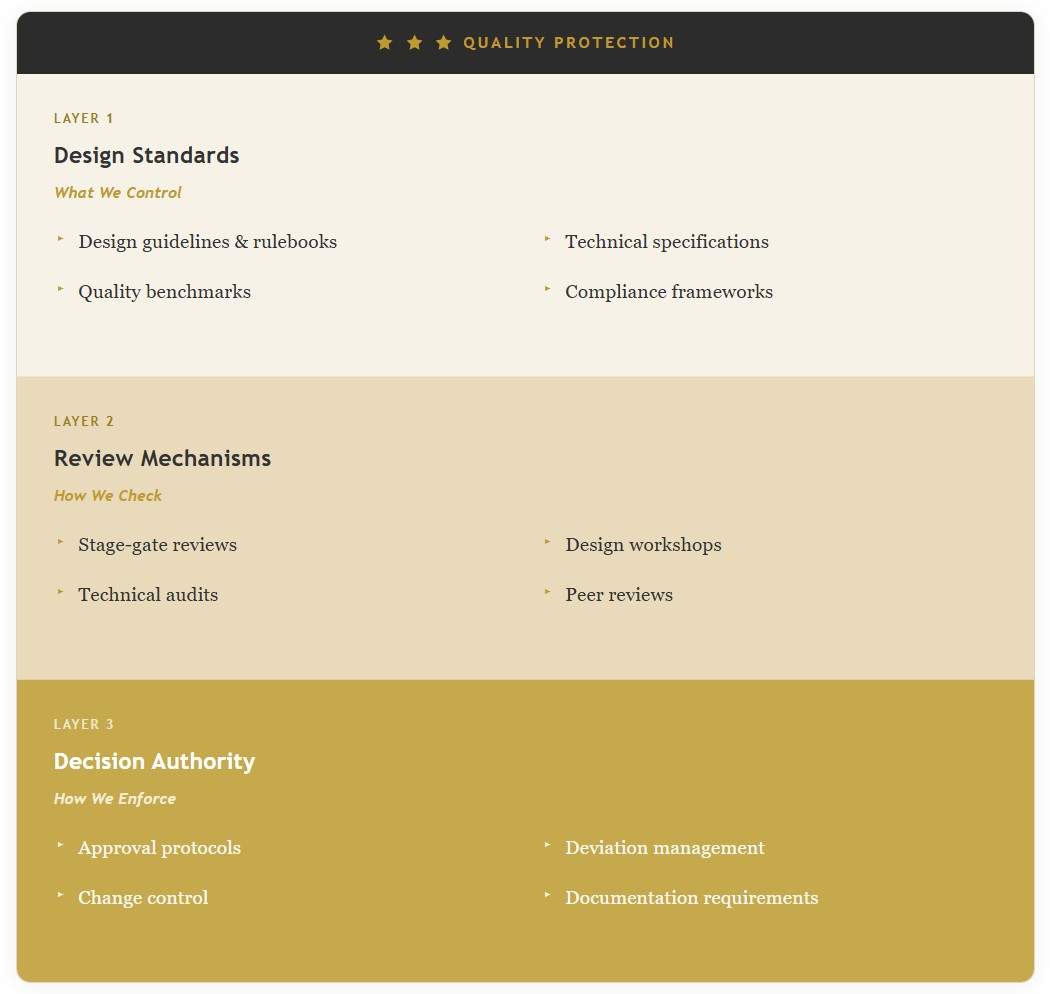
The framework I have developed and refined across major programme commissions organises Design Authority into three interdependent layers. Each layer addresses a distinct function—what we control, how we check, and how we enforce—and each is necessary. Remove any one layer and the system fails: standards without reviews are aspirational; reviews without authority are advisory; authority without standards is arbitrary.
Layer 1: Design Standards — What We Control
The foundation of quality expectations
Design Standards constitute the foundational layer of the framework—the documented, codified expectations that every consultant team must meet. This is where quality is defined, not merely assumed. In practice, this layer manifests as design guidelines and rulebooks that translate the client's vision and the masterplan intent into actionable criteria: material palettes, spatial proportions, detailing philosophies, environmental performance targets, and aesthetic principles that establish the programme's identity.
The 147-page design guideline I developed for a major programme exemplifies this layer at scale. It was not a style guide. It was a comprehensive governance document that established technical specifications for materials and performance criteria, quality benchmarks that defined the threshold between acceptable and excellent, and compliance frameworks that mapped client requirements against international codes and local regulations.
The critical challenge at this layer is usability. A comprehensive document that sits unread on a server is worse than useless—it provides the illusion of governance without the reality. The guideline was therefore structured for accessibility: visual-first where possible, with clear hierarchies between mandatory requirements and advisory recommendations, indexed for rapid reference during design development, and formatted for use in design review meetings rather than as bedside reading.
Fourteen diverse projects—from boutique hospitality to large-scale cultural institutions—each required different functional responses. The standards had to be robust enough to ensure consistency while flexible enough to accommodate genuine programmatic variation. This is the essential tension: standards that are too rigid stifle legitimate design responses; standards that are too loose permit the quality drift they were designed to prevent.
Layer 2: Review Mechanisms — How We Check
Systematic validation of compliance and quality
Standards without review mechanisms are declarations of intent—nothing more. The second layer transforms passive documentation into active governance through structured validation processes that ensure consultant work aligns with programme expectations at every significant stage of design development.
Stage-gate reviews provide the backbone: formal assessment points at key design milestones (concept, schematic, developed design, technical design) where consultant submissions are evaluated against the design standards before being authorised to proceed. These are not cursory presentations—they are structured evaluations against documented criteria, with clear pass/fail/conditional outcomes and recorded actions.
Design workshops operate differently, functioning as collaborative forums where consultants present emerging work, receive feedback from the Design Authority team and from peer consultants, and refine their proposals in dialogue rather than in isolation. The workshop format is critical for maintaining consultant engagement—it positions the Design Authority as a design partner rather than a regulatory obstacle, which is essential for securing creative buy-in from senior architects who may bristle at external oversight.
Technical audits provide systematic compliance checking against specifications, codes, and performance criteria. These are detailed, often discipline-specific, and focused on technical accuracy rather than design quality—complementing the more holistic assessment of stage-gate reviews with forensic scrutiny of specifications, calculations, and technical coordination.
Peer reviews introduce cross-team accountability, where consultant teams review each other's work against the shared standards. This mechanism is particularly valuable because it distributes the quality maintenance responsibility beyond the Design Authority team itself, creating a culture of collective accountability rather than centralised policing.
The rhythm of review—when sessions occur, how frequently, and who attends—must be calibrated against the programme's pace. Too frequent, and reviews become bureaucratic theatre that consultants resent. Too infrequent, and deviations embed themselves too deeply to correct without costly rework. The schedule must also account for the reality that thirty architectural practices operate on different timelines, with different stage completion dates—requiring a review calendar that accommodates multiple concurrent workflows without creating bottlenecks.
Layer 3: Decision Authority — How We Enforce
The enforcement mechanism that gives the framework teeth
This is the layer that separates genuine Design Authority from design advisory—and it is the layer that most organisations either underspecify or avoid entirely, because enforcement requires difficult conversations, clear hierarchies, and the willingness to say "no" to talented professionals who are accustomed to creative autonomy.
Approval protocols establish unambiguous clarity about who can approve what. Not every decision requires the same level of authority: routine material substitutions within approved palettes can be delegated; deviations from the established design language require senior sign-off; changes that affect cross-asset consistency require programme-level approval. The tiered structure prevents bottlenecks while protecting strategic decisions from being made at the wrong level.
Deviation management is perhaps the most sensitive function. Consultants will, inevitably, propose departures from the established standards—sometimes for legitimate design reasons, sometimes for commercial convenience. The deviation management process provides a structured path for these proposals: documented justification, impact assessment (particularly on cross-asset consistency), alternative analysis, and formal approval or rejection with recorded rationale. This protects both the programme (from uncontrolled variation) and the consultant (from arbitrary rejection).
Change control manages the evolution of the design standards themselves. A 147-page guideline cannot be static—it must respond to evolving client requirements, emerging technical constraints, and lessons learned during implementation. But uncontrolled evolution is as dangerous as rigidity, because changes to core standards have cascading implications across all fourteen assets. The change control process ensures that amendments are assessed for cross-programme impact, communicated to all affected teams, and documented with full version control.
Documentation requirements close the loop by ensuring that every significant decision—approvals, deviations, changes, review outcomes—is recorded with sufficient detail to reconstruct the rationale months or years later. This traceability is not administrative overhead; it is commercial protection and institutional learning, enabling the programme to defend its decisions and improve its processes.
The reality of this layer involves navigating the tension between flexibility and consistency. Too rigid, and the Design Authority becomes an impediment that consultants work around rather than through. Too flexible, and the authority exists in name only. The calibration requires technical confidence, interpersonal skill, and—critically—the seniority and credibility to make enforcement decisions that senior architects will respect even when they disagree.
"God is in the details."
— Ludwig Mies van der Rohe
Section 03
The Four Key Outcomes
The 3-Layer Design Authority Model is engineered to deliver four measurable outcomes. These are not aspirational goals—they are the operational consequences of a well-implemented framework, and they provide the criteria against which the Design Authority function should be evaluated.
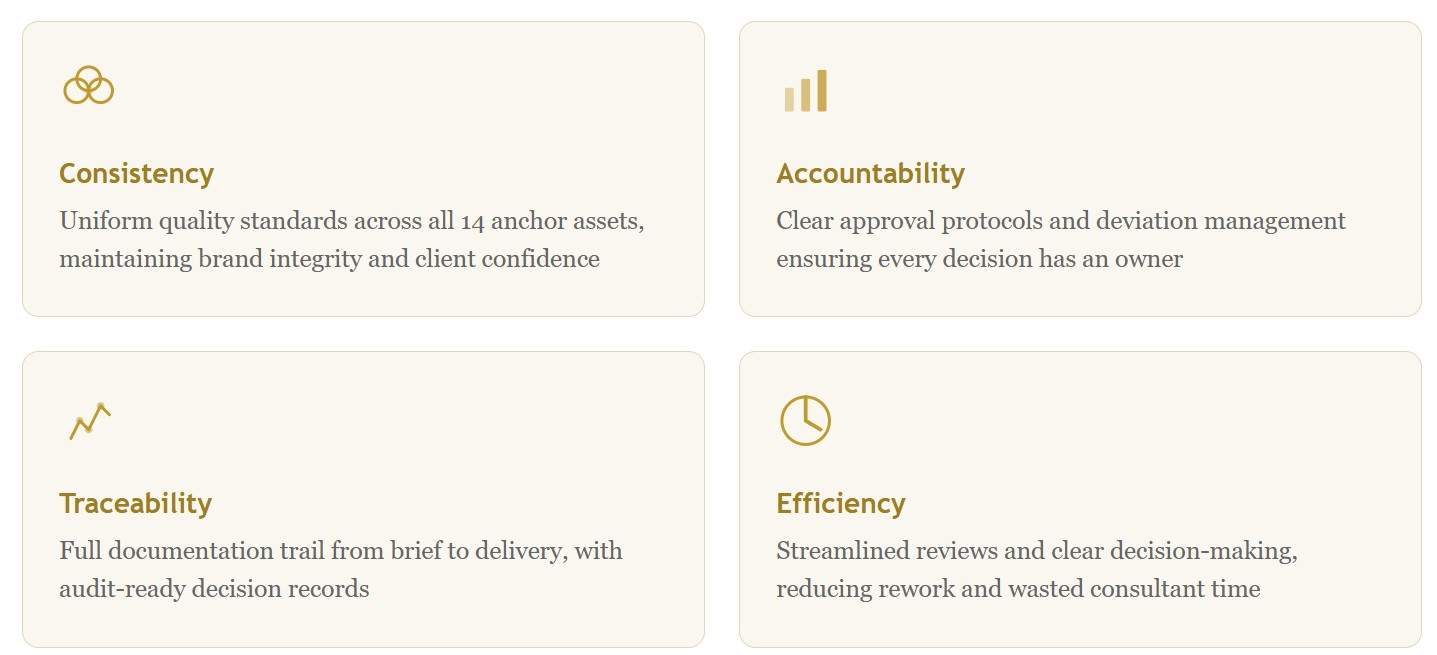
Consistency: The Primary Imperative
Consistency is not uniformity. Fourteen anchor assets should not look identical—they serve different programmes, occupy different positions in the masterplan, and address different user experiences. But they must read as members of the same family: sharing a material language, meeting the same quality threshold, and expressing a coherent design philosophy that reinforces the programme's identity.
The challenge is that consistency across diverse project types requires active curation. A boutique hotel and a major cultural venue have legitimately different spatial, material, and experiential requirements. The Design Authority must distinguish between appropriate variation (which enriches the programme) and quality divergence (which undermines it). This distinction is not algorithmic—it requires design judgement, programme knowledge, and the credibility to defend those judgements to senior architects.
Accountability: Ownership at Every Level
Without explicit accountability structures, responsibility diffuses. When a material substitution is discovered six months after the decision was made, with no record of who approved it or why, the programme has no mechanism for correction and no basis for preventing recurrence. Accountability structures—clear approval authorities, documented deviation processes, named decision-makers—ensure that every consequential choice has an owner who accepted responsibility at the time the decision was made.
Traceability: The Institutional Memory
Programmes of this scale run for years. Team members rotate. Client representatives change. Strategic priorities evolve. Without traceability—a comprehensive record of what was decided, by whom, when, and why—the programme loses its institutional memory and becomes vulnerable to revisiting settled decisions, contradicting earlier commitments, and losing the thread of strategic intent that connects early vision to eventual delivery.
Efficiency: The Commercial Case
Design Authority is sometimes perceived as bureaucratic overhead. The reality is precisely the opposite: a well-implemented framework reduces total programme cost by catching quality issues early (when they are cheap to fix) rather than late (when they require costly rework). Clear decision-making processes eliminate the iterative uncertainty that consumes consultant time. And documented standards reduce the ambiguity that generates unnecessary design iterations. The commercial case for Design Authority is not soft—it is quantifiable in reduced rework, shorter approval cycles, and fewer late-stage design changes.
Section 04
Coordinating Multiple Architects at Programme Scale
The phrase "30+ architects across fourteen assets" understates the human complexity involved. Each of those thirty practices has its own design culture, its own internal hierarchy, its own definition of quality, and—crucially—its own senior design leaders who are accustomed to being the final authority on design matters within their projects. The Design Authority role requires navigating these dynamics with a combination of technical credibility, diplomatic skill, and institutional authority.
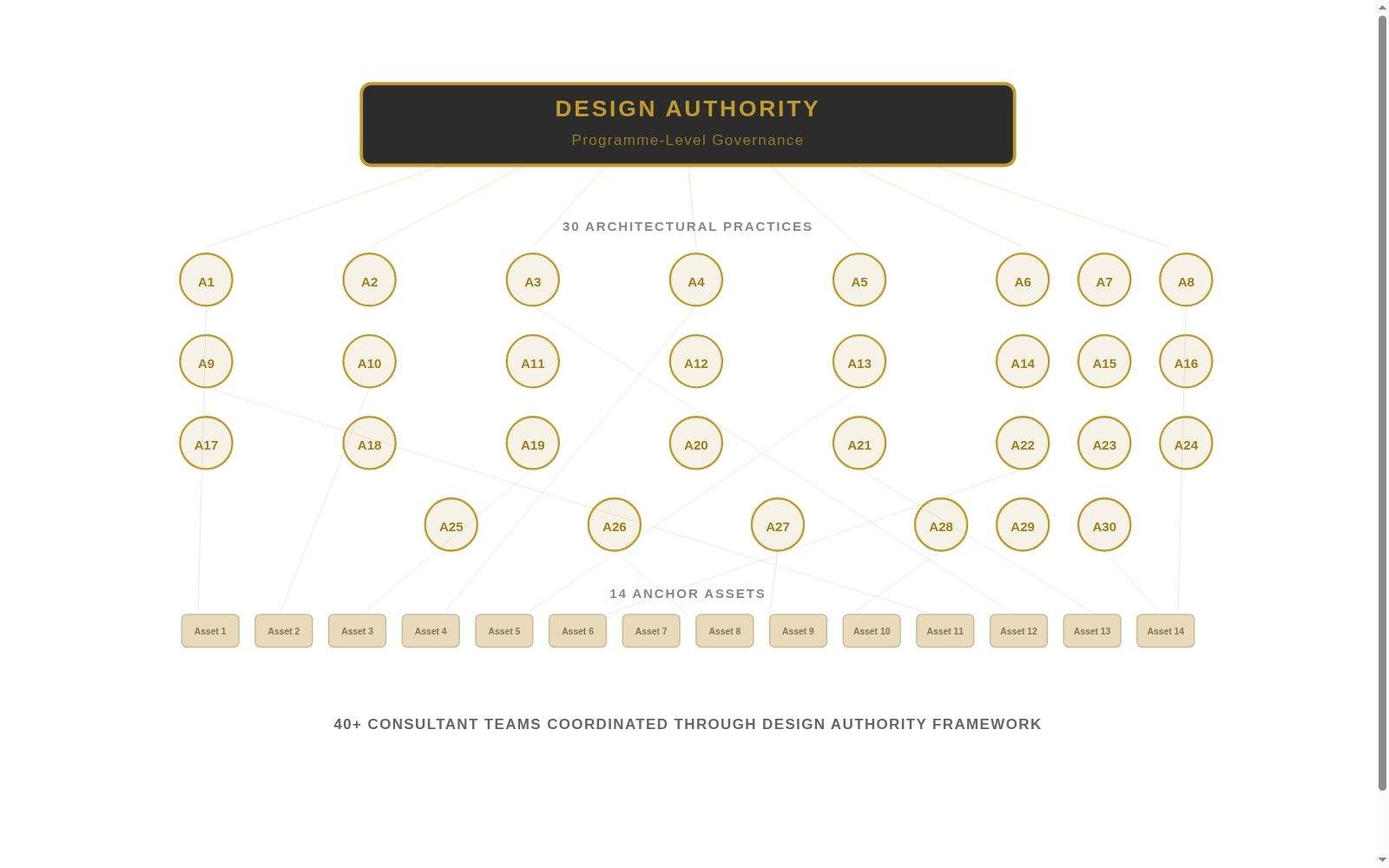
The critical distinction is between the design police model and the design coach model. The design police approach—reviewing work primarily to find fault—creates an adversarial dynamic that erodes trust, encourages consultants to hide problems rather than surface them, and ultimately undermines the quality it seeks to protect. The design coach approach—engaging with consultants as a senior design partner who shares accountability for the quality outcome—generates collaborative engagement, early problem-sharing, and collective ownership of the programme's design ambition.

Managing consultant egos requires a particular form of professional confidence. Senior architects at internationally recognised practices are not accustomed to external oversight of their design decisions. The Design Authority must command respect through demonstrated expertise—reviewing work with the technical depth and design literacy that earns the right to comment—while exercising authority with sufficient diplomatic skill to maintain productive relationships across what may be multi-year engagements.
Workshop coordination across multiple teams is a logistical and intellectual challenge. Cross-team workshops—where consultants working on adjacent or related assets review each other's work—create visibility, encourage informal consistency, and surface coordination issues before they become conflicts. But they require careful facilitation to prevent them from becoming defensive presentations rather than genuine design dialogues. The Design Authority sets the tone: collaborative, rigorous, focused on the programme's shared ambition rather than any individual firm's creative agenda.
Section 05
The 147-Page Design Guideline
A design guideline of this scale is, in itself, a design project. Its structure, organisation, and presentation directly determine whether forty-plus consultant teams will actually use it as a governance tool or treat it as an obligations document to be acknowledged and filed. The 147-page design guideline I developed was conceived as a working document first and a reference document second—designed to be opened in design meetings, cited in review sessions, and consulted during design development.
The structural approach was hierarchical. Overarching principles—the non-negotiable design philosophies that define the programme's identity—occupied the first tier: concise, visually communicated, memorable. Beneath those, application guidelines translated principles into discipline-specific criteria: architectural expression, landscape integration, interior standards, lighting philosophy, material specifications. The third tier provided technical detail: performance requirements, compliance matrices, specification schedules.

Visual communication was prioritised over text wherever possible. Precedent imagery, annotated diagrams, material mood boards, and spatial proportion studies communicated design intent more effectively than descriptive paragraphs—particularly when working across multiple design cultures, some of which operate primarily in languages other than English. The visual-first approach also enabled rapid assessment during reviews: a consultant's proposal could be visually benchmarked against the guideline's reference imagery without lengthy textual analysis.
The guideline was treated as a living document, subject to the same change control processes that governed the design itself. As the programme progressed, lessons learned from early-stage design development were incorporated, ambiguities were clarified based on consultant queries, and new requirements emerging from client evolution were integrated through a formal amendment process. Each version was numbered, distributed to all teams simultaneously, and accompanied by a change summary highlighting modifications from the previous issue. This discipline ensured that all forty-plus teams were working from the same current standard at all times—a seemingly basic requirement that, in practice, requires rigorous document control.
Training consultants to use the guideline was as important as writing it. Induction workshops for new team members, reference sessions at the start of each design stage, and integration of guideline requirements into review checklists ensured that the document was embedded in working practice rather than sitting alongside it. The goal was to make guideline compliance the path of least resistance—the natural way of working rather than an additional obligation.
Section 06
Real-World Application at Programme Scale
This framework was not developed in theory. It was forged in the reality of coordinating major programme delivery where the stakes—financial, reputational, and political—made design quality governance a non-negotiable requirement rather than an aspirational objective.
The scale of the operation is worth reiterating. A 147-page design guideline, authored from first principles, establishing governance standards for fourteen distinct anchor assets. Thirty architectural practices—each with their own design leadership, their own internal processes, and their own creative ambitions—coordinated through a unified framework that maintained consistency without suppressing the individual design excellence that each practice was appointed to deliver. Forty-plus consultant teams across all disciplines, each requiring clarity on standards, access to review forums, and understanding of the approval processes that governed their work.
The coordination infrastructure alone was substantial: review calendars synchronised across thirty practices operating at different design stages; workshop programmes that brought teams together for cross-asset dialogue; audit schedules that ensured systematic compliance checking without creating bottlenecks; and a documentation system that maintained decision traceability across hundreds of review sessions and thousands of individual design decisions.
"Quality means doing it right when no one is looking."
— Henry Ford
The success metrics were tangible. Consistency across the fourteen assets was maintained without homogeneity—each building retained its architectural identity while clearly belonging to the same programme family. Quality drift was arrested through early-stage detection in reviews rather than late-stage crisis management. Consultant relationships were maintained constructively across multi-year engagements—a critical achievement given that adversarial governance typically generates consultant disengagement or contractual dispute within months.
The framework's value was demonstrated most clearly in its handling of exceptions. When legitimate design innovation required departure from established standards—as it inevitably did—the deviation management process provided a structured path that protected creative ambition while maintaining programme control. The existence of a clear, fair, documented process for handling exceptions actually increased consultant confidence in the system, because it demonstrated that the Design Authority valued design excellence, not just compliance.
Conclusion
Design Authority as a Senior Leadership Competency
Design Authority at programme scale is not a junior coordination function. It is a senior leadership competency that requires deep design expertise (to evaluate consultant work with credibility), systematic governance thinking (to build and maintain the frameworks), interpersonal confidence (to enforce standards with senior architects), and commercial awareness (to balance quality aspirations with programme realities).
It is also, critically, different from project-level design management. A project design manager coordinates disciplines within one team. A Design Authority coordinates design intent across multiple teams, multiple projects, and multiple years—maintaining the strategic thread that connects the client's original vision to the eventual built reality. This programme-tier capability is essential for any large-scale development with multiple concurrent workstreams and multiple consultant appointments.
Over 27 years of practice, including direct experience coordinating thirty architectural practices across fourteen anchor assets through a comprehensive 3-layer governance framework, I have developed this approach into a systematic, transferable methodology. The principles are consistent; the application is calibrated to the specific programme's scale, culture, and strategic objectives.
For any programme where design quality across multiple consultant teams is a strategic requirement—not an aspiration but a deliverable—Design Authority provides the framework that makes consistency achievable, accountability structural, and excellence sustainable at scale.