Multi-Framework Governance Fluency: Why Adaptability Across Delivery Systems Defines Senior Lead

Introduction: The End of Single-Framework Practice
The architectural profession has operated under a comfortable assumption for decades: master one plan of work, and you can deliver anything. In the UK, that meant RIBA. In the US, AIA. In Australia, RAIA. The plan of work was a universal constant - a shared grammar between architect, client, and contractor that made governance predictable and project delivery sequential.
That assumption is now dangerously obsolete.
The GCC mega-project landscape has fundamentally altered the rules of engagement. Saudi Arabia alone has committed over $1 trillion in active development programmes — from NEOM's cognitive cities to the Red Sea's luxury tourism infrastructure, from Qiddiya's entertainment ecosystems to the Expo 2030 delivery machine in Riyadh. Each of these programmes has developed — or is actively developing — its own bespoke delivery framework, governance structure, and stage-gate system. The days of simply knowing your RIBA stages and assuming the world will align are over.
For senior design leaders, this represents both a threat and an opportunity. The threat is clear: professionals locked into a single system find themselves unable to translate their governance thinking when confronted with a client who doesn't recognise RIBA Stage 3 but demands a "Schematic Design Review with 13 sub-stage compliance checkpoints." The opportunity is equally clear: those who have built genuine fluency across multiple frameworks possess a rare and increasingly valuable capability — the ability to serve as a framework translator, bridging the gap between international best practice and client-specific delivery systems.
This article examines that capability in depth. Drawing on over 15 years of direct operational experience across three major governance frameworks — RIBA, the NEOM (Bespoke) Plan of Work, and OGC/APM Gateways - it argues that multi-framework fluency is no longer a specialist skill. It is the defining leadership competency for senior professionals operating in the world's most demanding project environments.
We must have order, allocating to each thing its proper place and giving to each thing its due according to its nature.
- Ludwig Mies van der Rohe
Mies van der Rohe was speaking about architectural clarity and structural integrity, but the principle applies with equal force to governance frameworks.
The first step is recognising that each project has a "nature" - a specific client culture, delivery context, and programme complexity - that determines which framework serves it best.
The second step - considerably harder - is building the intellectual discipline to allocate the right system to each project, rather than forcing every commission through a single, familiar process.
The Three Framework Pillars
The RIBA Plan of Work - International Standard
The RIBA Plan of Work remains the most widely recognised project delivery framework in international architectural practice. Now in its eighth iteration (2020 edition), it provides a structured sequence of eight stages — from Stage 0 (Strategic Definition) through Stage 7 (Use) — that maps the entire building lifecycle from inception to post-occupancy evaluation.
Its strengths are considerable: universal recognition across Commonwealth nations and beyond, a clear delineation of professional responsibilities at each stage, embedded sustainability checkpoints (since the 2013 revision), and deep integration with UK contractual frameworks including JCT and NEC. For traditional projects — a hospital in Northern Ireland, a cultural centre in the Gulf, a university campus in Southeast Asia — it provides a proven, predictable governance backbone.
But the RIBA system was designed for individual building projects, not for mega-programmes. Its stage boundaries assume a relatively linear progression from brief to occupation. It does not natively accommodate the parallel workstreams, iterative design loops, and multi-asset programme governance that characterise billion-dollar developments. When a client is simultaneously delivering 14 Tier 1 assets across a 26,500 km² site, the RIBA framework requires significant adaptation — or replacement.
The NEOM Plan of Work - Bespoke Mega-Project System
NEOM's Plan of Work represents a fundamentally different approach to project governance. Developed in-house to manage what is arguably the world's most ambitious development programme, it replaces the RIBA's eight stages with five primary phases — Pre-Design (PD), Schematic Design (SD), Design Development (DD), Construction Documentation (CD), and Construction Administration (CA) — each containing 13 or more defined sub-stages with specific deliverable requirements, review gates, and compliance checkpoints.
The NEOM system borrows from American AIA conventions in its nomenclature whilst embedding a level of granularity that exceeds any standard framework. Each sub-stage mandates specific deliverable packages, sign-off authorities, and quality benchmarks. The system is designed to manage enormous complexity: multiple design consultants working across parallel assets, each at different stages of development, all requiring coordination through a centralised Programme Management Office (PMO).
Operating within this system requires a fundamental mindset shift. A Design Director accustomed to RIBA stages must learn to think in terms of concurrent multi-asset stage management, where one project may be at SD while another is at DD and a third is cycling back through a PD review. The governance challenge is not sequential — it is orchestral.
OGC/APM Gateways — Programme Delivery Framework
The Office of Government Commerce (OGC) Gateway Process, now integrated with the Association for Project Management (APM) methodology, operates at a fundamentally different level from either RIBA or NEOM. It is not a design framework - it is a decision framework. Its five gateways (G1 through G5) represent investment decision points at which senior stakeholders assess whether a programme should proceed, pivot, or pause.
Gateway 1 (Business Justification) tests whether the strategic case holds. Gateway 2 (Delivery Strategy) evaluates the procurement and delivery approach. Gateway 3 (Investment Decision) is the critical commitment point. Gateway 4 (Readiness for Service) assesses operational preparedness. Gateway 5 (Operational Review) examines benefits realisation post-delivery.
In the GCC healthcare sector and in UK public-sector programmes, these gateways frequently overlay - and sometimes conflict with - the design stages being used by the architectural team. A Design Director must understand not only what design deliverables are required at each RIBA stage, but also what investment-level evidence the gateway review panel expects. The two systems serve different masters: one serves design quality; the other serves fiduciary accountability.
Framework Comparison Analysis
Understanding each framework in isolation is necessary but insufficient. The real leadership challenge lies in understanding how they align, overlap, and diverge — and where the governance gaps create risk.
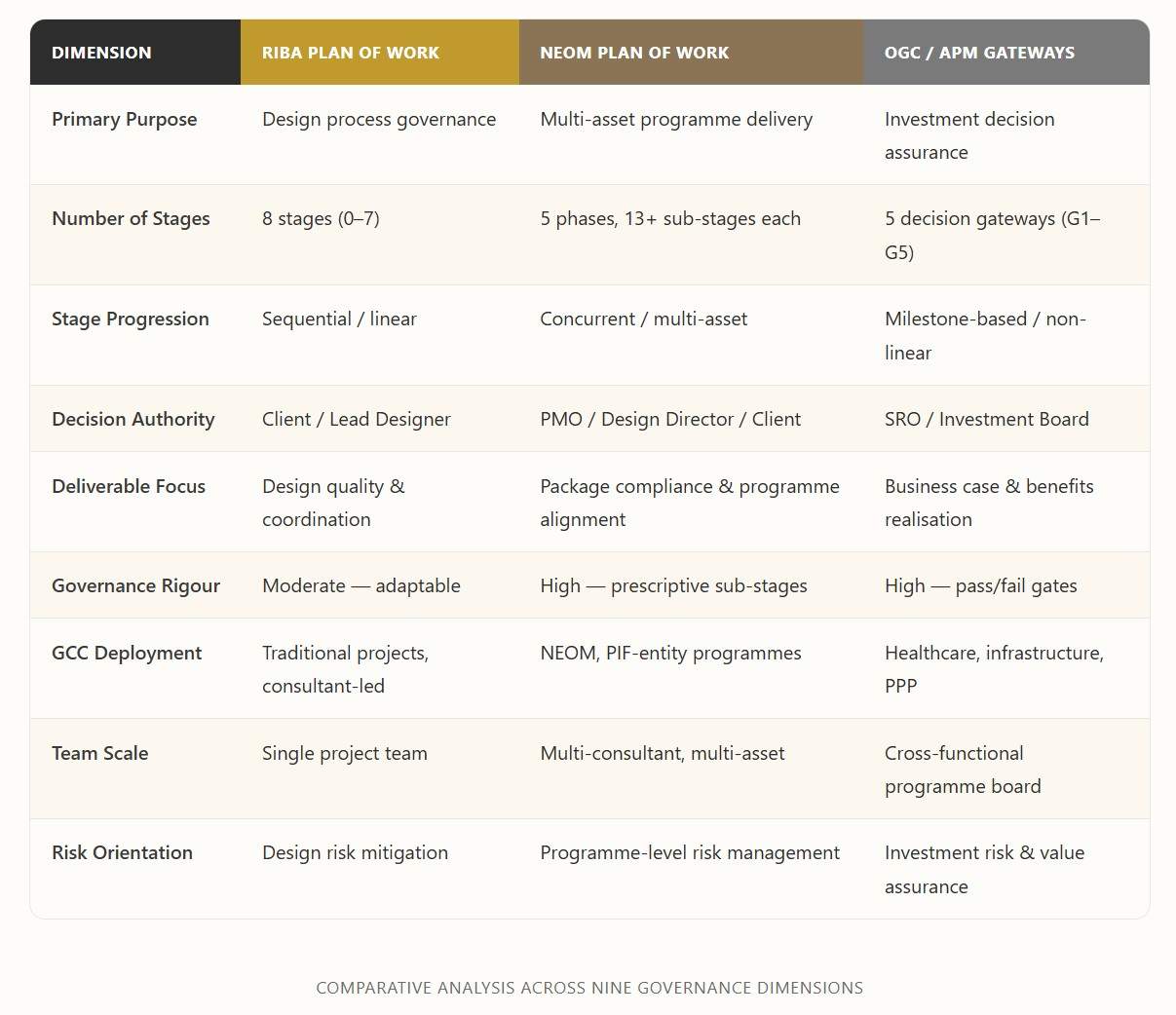
Stage Alignment - Where the Frameworks Converge
Despite their different origins and purposes, the three frameworks share structural parallels that an experienced practitioner can exploit. RIBA Stages 1–2 (Preparation & Brief through Concept Design) align broadly with NEOM's Pre-Design and Schematic Design phases, and map to the period between OGC Gateway 1 (Business Justification) and Gateway 2 (Delivery Strategy). This is the strategic design corridor — the zone where design intent, programme feasibility, and investment justification must converge.
Similarly, RIBA Stages 3–4 (Spatial Coordination through Technical Design) correspond to NEOM's Design Development phase and the critical period approaching OGC Gateway 3 (Investment Decision). This is where the governance demands intensify: the design team must simultaneously demonstrate design coordination maturity (for RIBA compliance), sub-stage deliverable completeness (for NEOM compliance), and investment readiness (for gateway clearance).
Where the Frameworks Diverge - And Why It Matters
The critical divergences occur in three areas.
First, granularity: NEOM's 13+ sub-stages per phase create a level of governance density that RIBA does not anticipate, meaning deliverable expectations can be misaligned if the team defaults to RIBA-standard outputs.
Second, concurrency: RIBA assumes a single project trajectory, whereas NEOM demands simultaneous governance of multiple assets at different stages - requiring a programme-level view that RIBA does not natively provide.
Third, decision authority: OGC gateways place ultimate authority with the Senior Responsible Owner (SRO) and investment board, not with the design lead - a fundamental shift in power dynamics that design directors must navigate carefully.
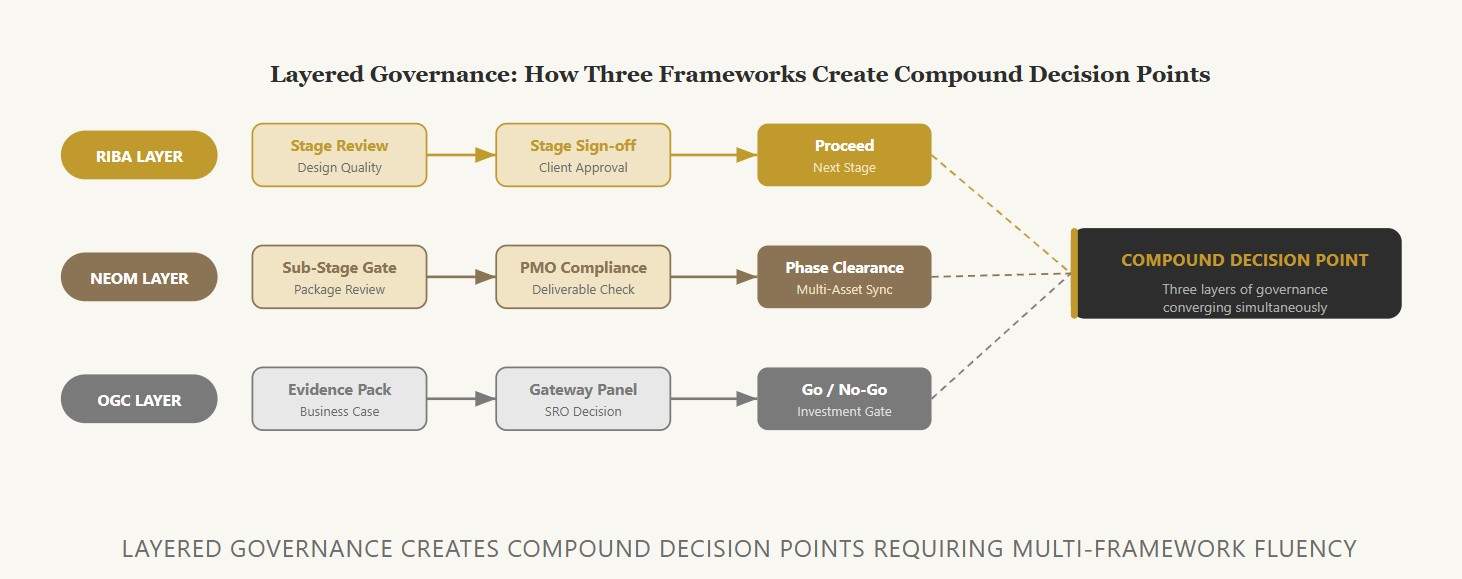
The practical implication is stark. At critical junctures — typically around the transition from concept to detailed design — a senior design leader may face three simultaneous governance demands: a RIBA stage sign-off assessing design quality, a NEOM sub-stage gate assessing deliverable package compliance, and an OGC gateway assessing investment readiness. Each demands different evidence, serves a different authority, and operates on a different risk calculus. Navigating all three requires not just knowledge of each system, but the ability to synthesise their requirements into a single coherent governance narrative.
Real-World Application: Three Case Studies in Framework Fluency
Theory is necessary but insufficient. The true test of multi-framework fluency lies in its application under real-world pressure — where deadlines compress, stakeholder expectations conflict, and governance demands compound. The following three case studies illustrate how framework fluency operates in practice across fundamentally different project contexts.
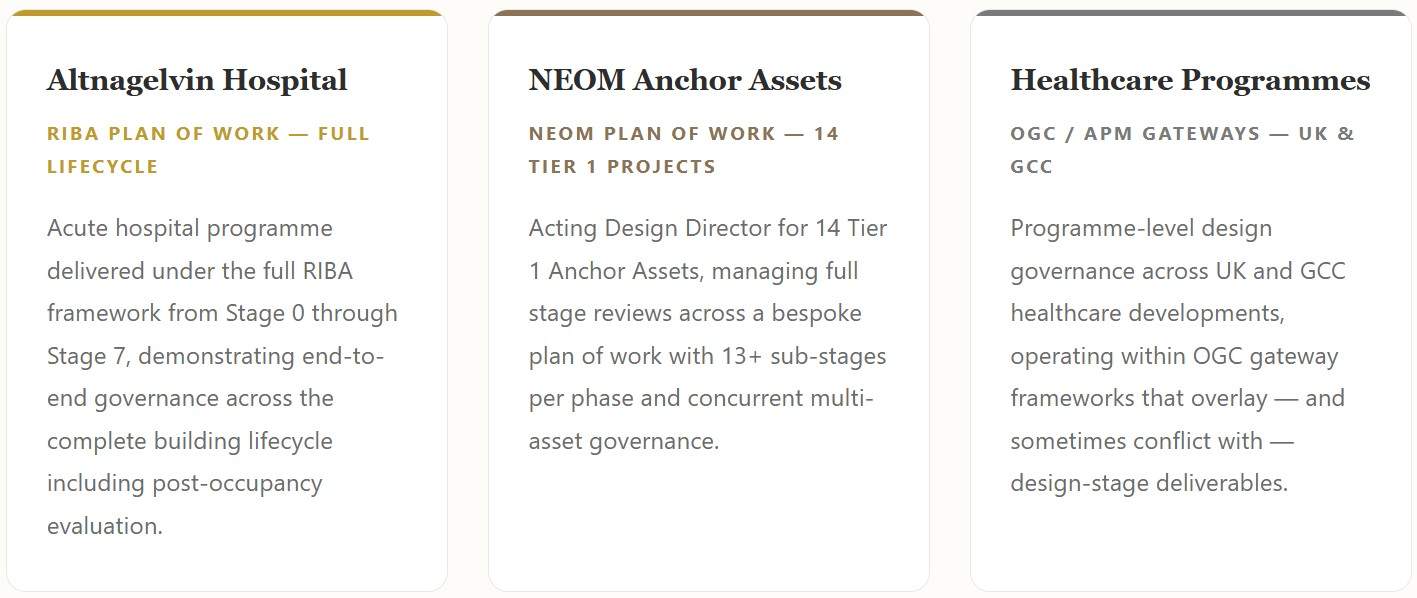
Case Study 1: Altnagelvin Hospital - RIBA Full Lifecycle
The Altnagelvin Hospital project represents the classical application of the RIBA Plan of Work in its purest form: a complex acute healthcare facility delivered through all eight stages, from Strategic Definition through to Use. What makes this project instructive is not its adherence to the framework — any competent architect can follow RIBA stages — but the depth of governance required at each transition point within the healthcare context.
Healthcare projects demand a level of clinical stakeholder engagement that tests the RIBA framework's flexibility. Between Stage 2 (Concept Design) and Stage 3 (Spatial Coordination), the governance requirements expand dramatically: clinical adjacency reviews, infection control compliance, equipment planning coordination, and Health Building Note (HBN) compliance checks all layer onto the standard RIBA deliverables. The Design Director's role is to ensure that these additional governance requirements are integrated into the stage review process — not bolted on as afterthoughts.
The full lifecycle experience — through construction, handover, and into use — provides a governance perspective that many architects never acquire. Post-occupancy evaluation under Stage 7 feeds back into strategic lessons that inform future Stage 0 thinking. This circular governance loop is fundamental to building the institutional knowledge that multi-framework fluency requires.
Case Study 2: NEOM Anchor Assets - Bespoke System at Scale
The NEOM Anchor Assets programme represents the opposite end of the governance spectrum. As Acting Design Director responsible for 14 Tier 1 projects, the challenge was not following a familiar framework but operating within an entirely bespoke system that had no external precedent.
The NEOM Plan of Work demanded a fundamental recalibration of governance instincts. Where RIBA training creates an expectation of sequential stage progression — brief, then concept, then developed design, in orderly succession — NEOM required the simultaneous management of assets at different stages. On any given week, three projects might be at Schematic Design review, two at Design Development gate, and one cycling back through Pre-Design revisions following a scope change. The governance challenge was not depth but breadth and simultaneity.
The 13+ sub-stages within each phase added a further layer of complexity. Each sub-stage carried specific deliverable requirements, sign-off authorities, and quality benchmarks that did not map neatly onto RIBA equivalents. A "Stage 3 complete" declaration in RIBA terms might satisfy only three of seven NEOM sub-stage requirements in the equivalent DD phase. The translation effort was constant and demanding.
Perhaps most critically, the NEOM system required a programme-level governance perspective that transcended individual projects. Stage reviews were not just about whether a single asset had achieved design maturity — they were about whether the asset's stage progression was aligned with the broader programme timeline, infrastructure delivery schedule, and interdependency matrix. This is programme governance applied to design, and it is a capability that pure RIBA experience does not build.
Case Study 3: Healthcare Programmes - Gateway Overlay
The UK and GCC healthcare programme experience introduced a third governance dimension: the investment decision framework. OGC/APM gateways operate at the programme level, testing whether the strategic case, delivery strategy, and investment decision remain sound at defined milestones. For a Design Director, this means preparing evidence packs that speak not to design quality (RIBA's concern) but to value for money, benefits realisation, and delivery confidence (the gateway panel's concern).
The practical challenge is that gateway evidence requirements often demand information that the design process has not yet produced — or has produced in a format that doesn't satisfy gateway panel expectations. A RIBA Stage 2 report demonstrating concept design quality may need to be repackaged as a Gateway 2 evidence document demonstrating procurement readiness. The content may overlap, but the framing, emphasis, and narrative structure are fundamentally different.
Switching between these frameworks mid-programme — which healthcare developments routinely require — demands a level of intellectual agility that goes beyond technical competence. It requires understanding which governance language each audience speaks and being able to translate the same project reality into multiple governance narratives without losing accuracy or credibility.
The measure of intelligence is the ability to change.
— Albert Einstein
The Leadership Imperative: Why This Matters at Director+ Level
Multi-framework governance fluency is not a technical skill — it is a leadership competency. The distinction matters because it determines where in the organisation this capability sits and how it is deployed.
At project architect level, governance fluency means knowing which deliverables are required at each stage. At Design Director level, it means something fundamentally different: it means understanding why each framework exists, whose interests it serves, and how to navigate the political and organisational dynamics that governance systems encode. Every framework embeds assumptions about power, accountability, and risk. The leader who understands these assumptions can navigate governance not as bureaucratic compliance but as strategic positioning.
Client Confidence and Consultant Credibility
In the GCC mega-project market, clients are increasingly sophisticated governance buyers. A development authority like PIF, NEOM, or the Royal Commission for AlUla does not simply want an architect who can design well — they want a design leader who can operate within their system without requiring extensive onboarding. The ability to walk into a client organisation and immediately understand their governance framework — or, better, to demonstrate prior experience with a comparable bespoke system — is a powerful credibility signal.
In tender and interview situations, this capability creates a measurable competitive advantage. When a panel asks "How would you manage stage reviews across a programme of this scale?", the candidate who can reference direct experience across RIBA, bespoke, and gateway frameworks — with specific examples of navigating compound governance points — demonstrates a level of operational readiness that competitors locked into a single system cannot match.
Risk Mitigation Through Framework Fluency
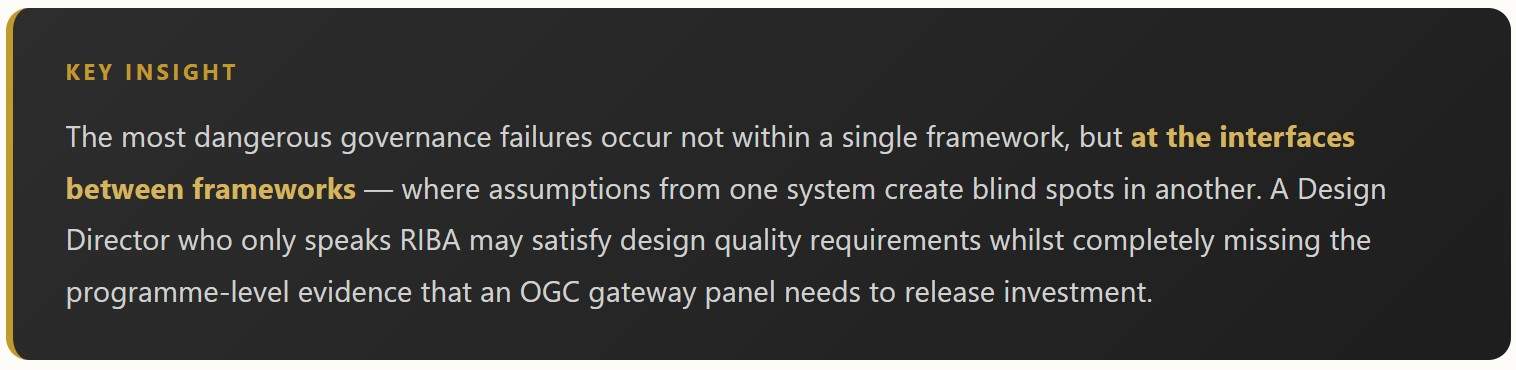
Governance failures in mega-projects are rarely caused by a lack of frameworks. They are caused by framework misapplication — using the wrong governance tool for the context, or failing to recognise where framework assumptions create blind spots. A Design Director with multi-framework experience can identify these risks proactively because they have seen how different systems handle the same governance challenge. They know where RIBA is weak (programme-level coordination), where bespoke systems are vulnerable (lack of external benchmarking), and where gateways can become obstacles (over-emphasis on documentation at the expense of design quality).
This diagnostic capability — the ability to assess a governance framework's fitness for purpose and recommend adaptations — is one of the most valuable services a senior design leader can offer. It is also one of the rarest.
Practical Framework Translation: A Working Guide
Fluency without practicality is academic. This section addresses the operational challenge: how to translate deliverables, expectations, and governance requirements across frameworks in real-time project conditions.
The Translation Matrix
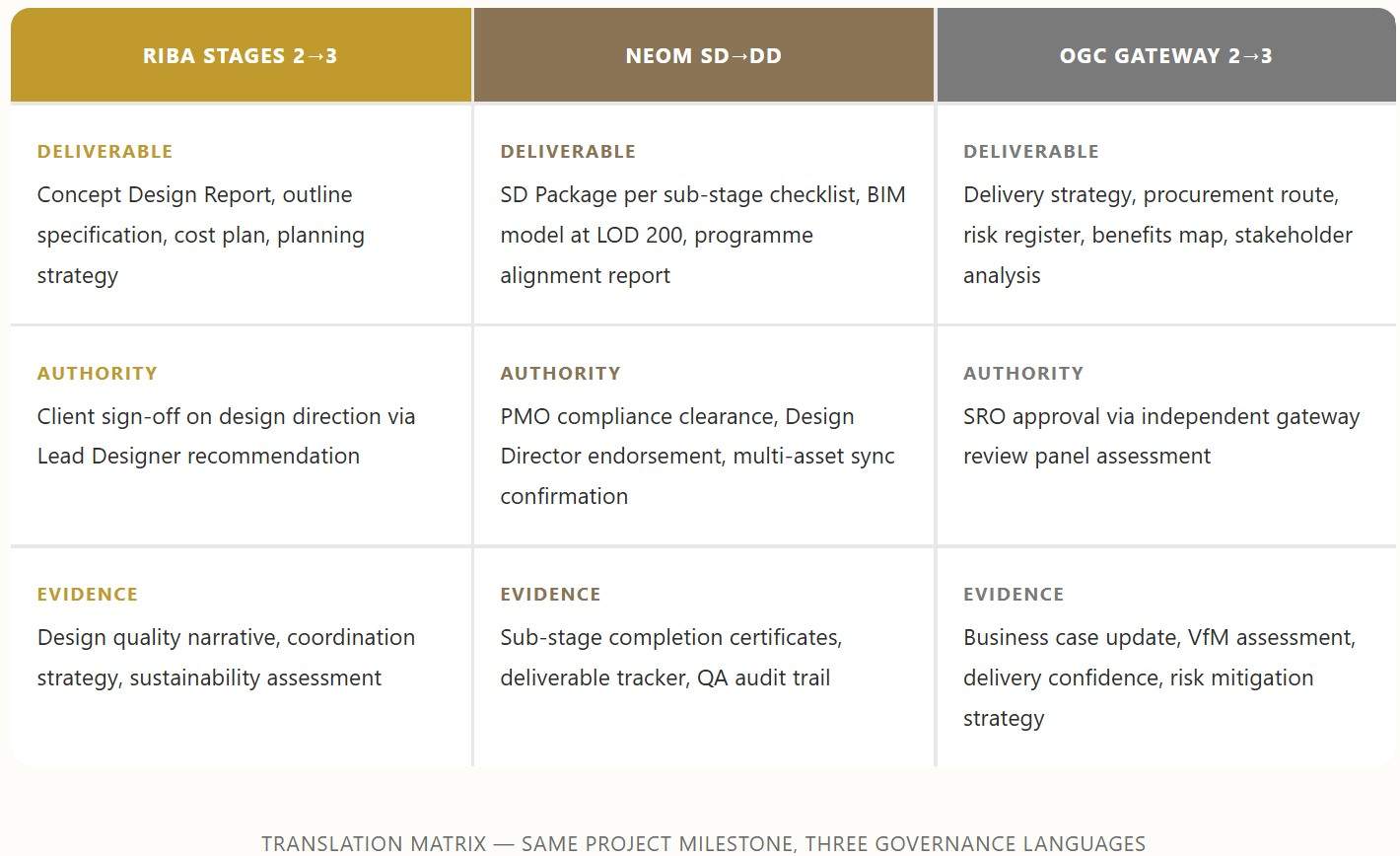
At its core, framework translation requires mapping three dimensions across systems: what is delivered (deliverables), who decides (authority), and what evidence is required (governance documentation). The following matrix illustrates how a single project milestone — the transition from concept to detailed design — translates across the three frameworks:
Common Pitfalls in Framework Transition
Assuming equivalence where none exists. RIBA Stage 3 is not the same as NEOM DD, despite superficial similarities. The deliverable expectations, granularity requirements, and sign-off protocols differ materially. Treating them as interchangeable creates governance gaps.
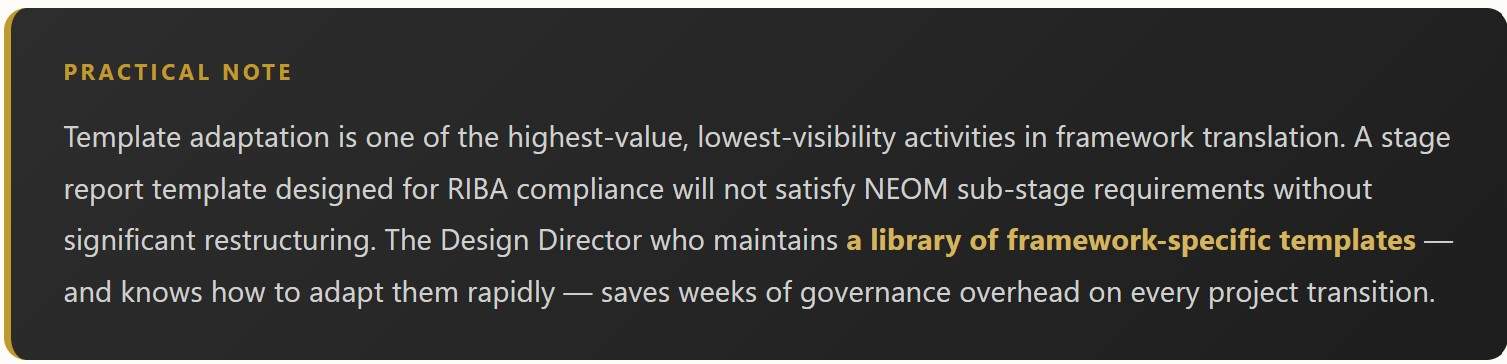
Defaulting to the familiar system under pressure. When timelines compress, teams instinctively revert to the framework they know best. A RIBA-trained team on a NEOM project will start producing RIBA-format stage reports that don't satisfy NEOM sub-stage requirements. The Design Director must enforce framework discipline even — especially — under pressure.
Underestimating the "translation overhead." Moving between frameworks is not free. It requires time for deliverable reformatting, team briefing, and authority mapping. Programmes that fail to budget for this overhead invariably encounter governance delays at stage transitions.
Neglecting the political dimension. Each framework encodes assumptions about who holds power at each decision point. Misreading the authority structure — presenting design recommendations to a gateway panel that expects investment evidence, for example — undermines credibility and wastes governance bandwidth.
Treating governance as compliance rather than strategy. The most effective framework translators don't simply satisfy each system's requirements — they use governance strategically, leveraging stage reviews and gateway assessments as opportunities to build stakeholder confidence and secure design intent.
Team Briefing for Framework Transitions
When a project team transitions between frameworks — whether because the client adopts a bespoke system, because programme-level gateways overlay the design framework, or because the team moves between clients operating different systems — the Design Director must execute a structured transition briefing. This is not a casual team meeting; it is a governance reset that ensures every team member understands the new rules of engagement.
An effective transition briefing covers four elements: the new framework's structure and terminology (what the stages are called and what they mean); the deliverable mapping (how existing work products translate into the new system's requirements); the authority matrix (who approves what and at which gate); and the governance calendar (when reviews occur and what lead times apply). Without this structured briefing, teams default to assumptions from the previous framework — and governance failures follow.
Conclusion: The Future is Hybrid — And the Future is Now
The trajectory is clear. As GCC mega-projects continue to mature, as PIF entities develop increasingly sophisticated delivery systems, and as international development authorities learn from programmes like NEOM, the demand for hybrid and bespoke governance frameworks will only accelerate. The next generation of mega-projects — whether it is Qiddiya's entertainment ecosystem, Expo 2030's delivery programme, or the next wave of ROSHN developments — will not adopt RIBA, AIA, or OGC wholesale. They will build their own systems, drawing selectively from existing frameworks and adding layers of programme-specific governance.
For the senior design leader, this means that framework fluency is not a static competency. It is a dynamic capability — the ability to learn, adapt, and operate within new governance systems rapidly, drawing on deep experience with existing frameworks to accelerate comprehension and build client confidence from day one. The professional who has spent 15 or more years operating across multiple systems has not just accumulated knowledge; they have built the cognitive infrastructure for rapid framework adaptation that no training course can replicate.
This is the difference between a specialist and a strategist. The specialist knows one system deeply. The strategist understands the principles that all systems encode — accountability, risk management, design quality assurance, stakeholder confidence — and can deploy those principles in any governance context. In a market that is actively inventing new delivery systems for unprecedented projects, the strategist's fluency is not a nice-to-have. It is the fundamental qualification for senior design leadership.
The illiterate of the 21st century will not be those who cannot read and write, but those who cannot learn, unlearn, and relearn.
— Alvin Toffler
The GCC's mega-project landscape is the most demanding governance environment in global practice. It rewards the prepared mind — and it punishes the rigid one. Multi-framework governance fluency is the prepared mind in action: disciplined, adaptable, and strategically deployed.