Stakeholder Management & Engagement: Navigating Multi-Tier Client Ecosystems in Giga-Projects
In the world of giga-projects — multi-billion-dollar, nationally significant developments that redefine skylines, economies, and urban identity — stakeholder management is not a soft skill. It is the single most critical competency that determines whether a programme delivers on its founding vision or descends into fragmentation, delay, and strategic drift.
Traditional stakeholder management frameworks were conceived for projects with identifiable sponsors, clear governance lines, and a manageable cast of decision-makers. They assume a relatively flat hierarchy, predictable communication channels, and stakeholders whose interests can be mapped on a simple two-by-two matrix and largely left alone. In a giga-project context, these assumptions collapse entirely.
The GCC region — and Saudi Arabia's Vision 2030 programme in particular — has produced a generation of projects that operate at a scale and complexity unprecedented in the built environment. These are not conventional developments with a client, a consultant, and a contractor. They are multi-tier client ecosystems: interconnected webs of royal patrons, executive boards, programme directors, investment committees, regulatory bodies, design consultancies, PMC organisations, contractors, and end-user communities — each with distinct authority levels, engagement expectations, communication preferences, and strategic priorities.
Navigating this ecosystem demands more than project management methodology. It requires political acumen, cultural intelligence, and the ability to calibrate communication — in both content and cadence — across four or more tiers of decision-making authority simultaneously. This article presents a framework for exactly that: a stakeholder matrix and engagement strategy forged through 27 years of practice, refined at the highest levels of giga-project delivery in the Middle East.
Section 01
The Stakeholder Complexity Problem
Consider the scale: a giga-project comprising 14 distinct anchor assets, each with its own design identity, programme, consultant team, and delivery timeline - yet all operating under a unified founding vision established at the highest levels of national leadership. Across those assets, 40+ consultant teams are engaged simultaneously, each bringing their own design ambitions, contractual obligations, and communication expectations. Above them sit layers of programme management, executive leadership, and - in the GCC context - royal or sovereign-fund decision-makers whose engagement requires a fundamentally different approach to that of a design consultant workshop.
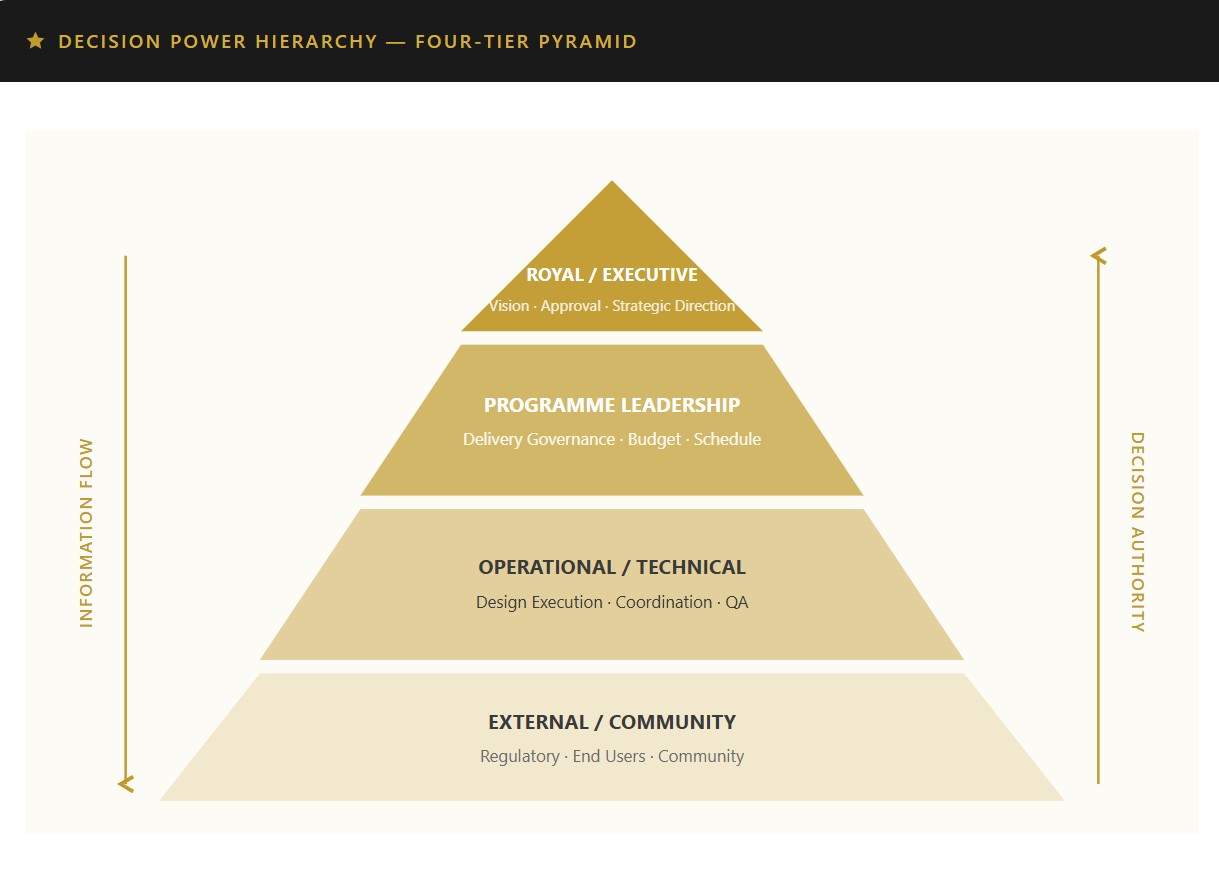
The decision-making hierarchy in these environments is not merely organisational - it is structurally tiered:
Royal / Executive Tier: Vision ownership, strategic approval authority, national priority alignment
Programme Tier: Delivery oversight, budget governance, schedule accountability
Operational Tier: Design execution, technical coordination, quality assurance
External Tier: Regulatory compliance, community engagement, end-user readiness
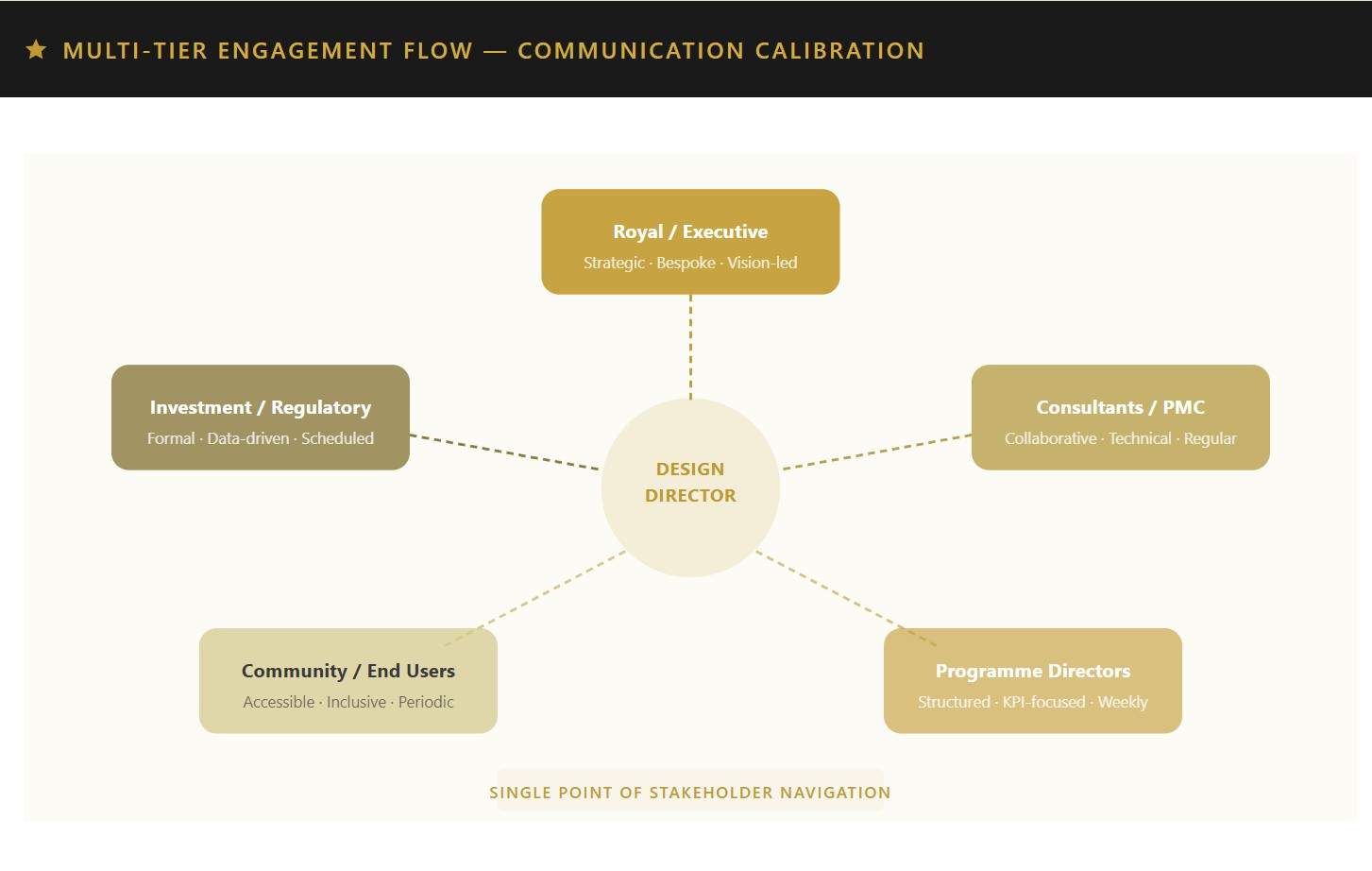
Each tier operates on different timescales, consumes information differently, and has distinct tolerance for detail, ambiguity, and risk. A presentation that works for a programme director - structured, data-rich, focused on KPIs and milestones - will fail entirely in a founding board setting, where the conversation centres on vision alignment, strategic narrative, and the political implications of design decisions.
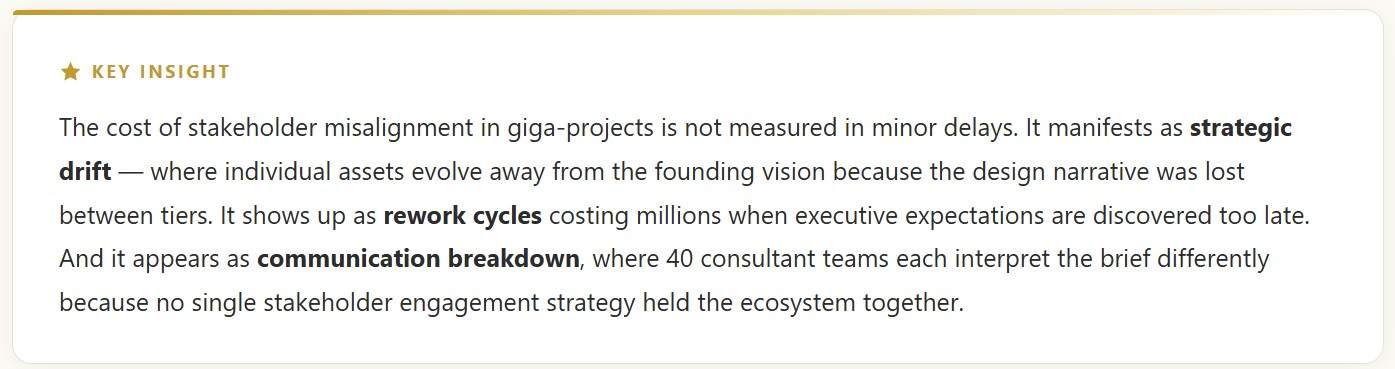
The fundamental problem is this: "one size fits all" engagement fails at scale. The same email update, the same presentation format, the same meeting cadence cannot serve a royal patron and a mechanical engineering sub-consultant. Yet in practice, this is exactly what most stakeholder management approaches attempt — and exactly why they fail when confronted with the multi-tier complexity of giga-project delivery.
Section 02
The Stakeholder Matrix Framework
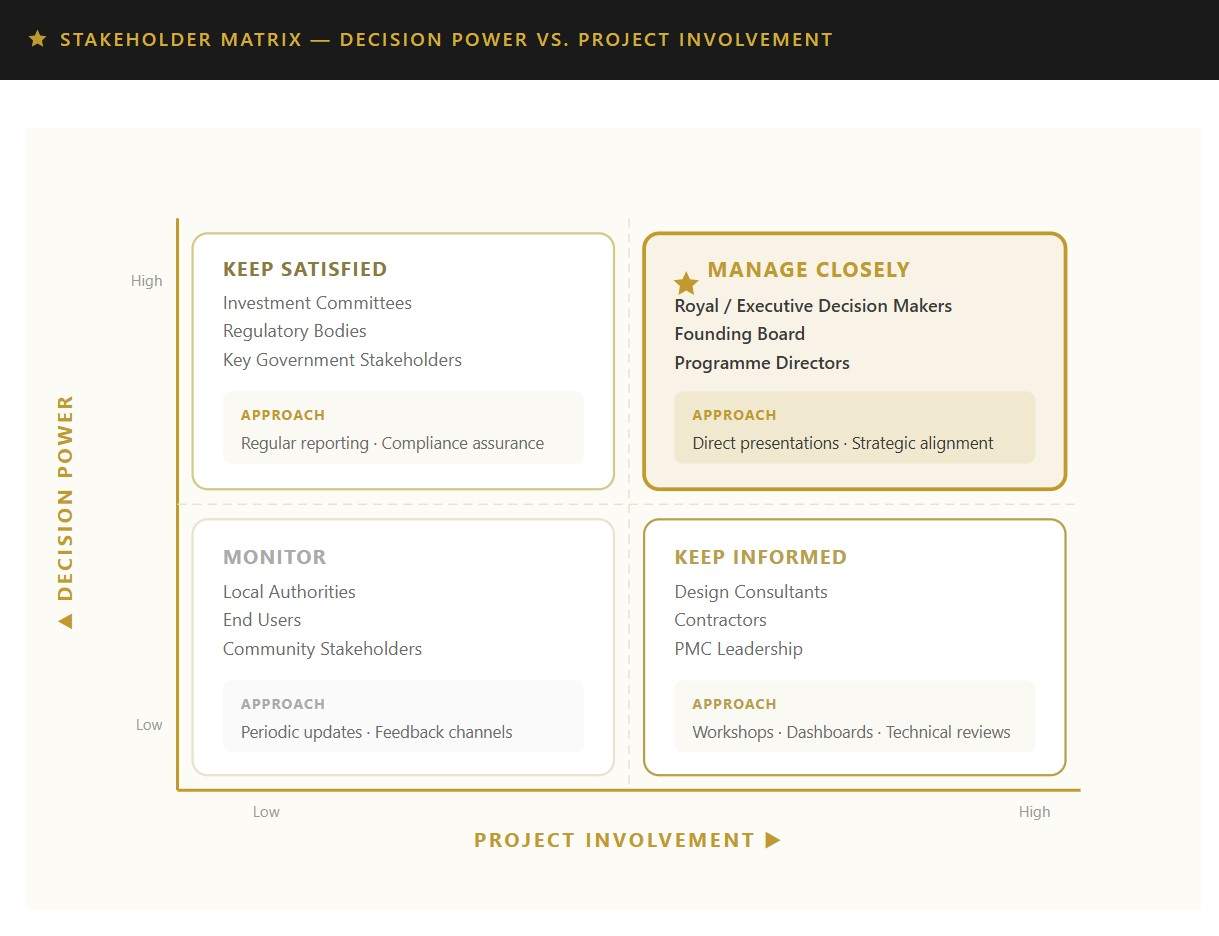
Effective stakeholder management at giga-project scale requires a structured framework that maps stakeholders not by organisational chart, but by two critical dimensions: Decision Power (their authority to approve, redirect, or halt) and Project Involvement (their proximity to day-to-day delivery). This matrix produces four engagement tiers, each demanding a distinct communication strategy, frequency, and risk awareness.
Understanding the Decision Power Hierarchy
The matrix is deceptively simple in structure but demands nuanced application. Each quadrant represents not just a category of stakeholder but a fundamentally different mode of engagement — different in content, format, frequency, cultural expectation, and risk profile. The critical error most professionals make is treating all four quadrants with the same communication methodology. In a giga-project, that error is fatal to programme cohesion.
Manage Closely
Royal / Executive Decision Makers, Founding Boards, Programme Directors
High power · High involvement
Engagement Approach
Direct presentations, personalised updates, strategic alignment sessions. Communication is bespoke, high-touch, and calibrated to the individual's priorities and communication style.
Frequency
As needed — driven by decision points, not calendar cycles. Every interaction must deliver strategic value.
⚠ Risk: Losing strategic buy-in, misaligned vision, political exposure
Keep Satisfied
Investment Committees, Regulatory Bodies, Key Government Stakeholders
High power · Lower direct involvement
Engagement Approach
Regular structured reporting, compliance assurance, transparent risk disclosure. Communication is formal, data-driven, and aligned with governance protocols.
Frequency
Scheduled cycles — monthly or quarterly reporting, with ad hoc escalation for material risks.
⚠ Risk: Regulatory delays, funding constraints, governance gaps
Keep Informed
Design Consultants, Contractors, PMC Leadership
Lower power · High involvement
Engagement Approach
Workshop invitations, progress dashboards, technical review sessions. Communication is collaborative, detail-oriented, and designed to maintain execution alignment.
Frequency
Regular and structured — weekly or fortnightly, with additional touchpoints around design milestones.
⚠ Risk: Execution misalignment, quality drift, brief misinterpretation
Monitor
Local Authorities, End Users, Community Stakeholders
Lower power · Lower direct involvement
Engagement Approach
Periodic updates, community engagement events, structured feedback channels. Communication is accessible, non-technical, and focused on awareness and inclusion.
Frequency
As appropriate — milestone-driven, with standing feedback mechanisms for ongoing input.
⚠ Risk: Community opposition, operational readiness gaps
The critical distinction between this framework and a standard stakeholder map is that it is operationally prescriptive. It does not simply categorise stakeholders — it dictates specific engagement methodologies, frequency cadences, and risk mitigations for each tier. In a programme with 14 anchor assets and 40+ consultant teams, this level of prescription is not optional. Without it, communication defaults to the loudest voice or the most immediate deadline, and strategic coherence is lost.
"Architecture is not about building. It is about the process of making, the process of engaging, the process of bringing people together to a common vision. The building is just the residue of that process."
— Renzo Piano
This insight applies with particular force to giga-project stakeholder management. The built outcome — the anchor asset, the masterplan, the destination — is ultimately the residue of hundreds of stakeholder interactions, each calibrated to the right tier, at the right frequency, with the right content. When those interactions are managed poorly, the built outcome reflects it — in misalignment, compromise, and lost ambition. When they are managed well, the founding vision survives intact through every tier of decision-making.
This is your heading
You can write here as much as you want, this text will always look nice, whether you write longer paragraphs or just a few words. Click here and try it out.
Section 03
The Engagement Strategy in Practice
Theory is necessary but insufficient. The difference between a stakeholder matrix on a slide and a functional stakeholder management capability lies entirely in execution - the daily practice of tailoring communication to the person in front of you, the decision at hand, and the political landscape of the moment.
Royal and Executive Presentations
Presentations at the royal or executive tier are fundamentally different from any other form of project communication. They are not progress updates. They are strategic alignment events — moments where the founding vision is either reinforced or eroded. The content must be curated, not comprehensive. The narrative must connect the design proposition to the strategic ambition - national identity, economic diversification, cultural legacy - not to programme milestones or construction sequences.
The format is typically visual-led with minimal text, supported by a spoken narrative rather than written decks. The pace is controlled by the audience, not the presenter. Questions may arrive that test political awareness as much as technical knowledge. Preparation for these sessions involves understanding not just the project but the strategic context in which decisions are being made - competing priorities, political dynamics, and the personal investment of key individuals in the project's success.
Founding Board Dynamics
Founding boards in the GCC context - particularly those associated with PIF entities and national development programmes - embody a persistent tension: vision versus delivery. Board members hold the founding ambition and expect it to be honoured, while simultaneously demanding evidence of deliverability, cost control, and risk management. The effective stakeholder manager navigates this tension by framing every design decision in terms of vision preservation, not merely technical rationale.
Direct founding board presentations require a particular discipline: the ability to distil months of multi-team design development into a narrative that a board member can absorb in minutes, with confidence that the detail underneath is robust. This is not summarisation - it is strategic translation.
Multi-Consultant Coordination
Managing 40+ consultant teams simultaneously is an exercise in controlled coherence. Each team has its own design ambitions, contractual obligations, programme pressures, and internal dynamics. Left unmanaged, they will optimise for their individual scope at the expense of programme-wide coherence. The engagement strategy for this tier is built around structured touchpoints - design review workshops, coordination forums, progress dashboards - that maintain alignment without suffocating creativity.
The critical skill is knowing when to coordinate and when to direct. In the early design stages, consultants need creative latitude. As the programme matures and interdependencies solidify, coordination becomes more prescriptive. Timing this transition incorrectly - too early, and creativity is stifled; too late, and misalignment becomes embedded - is one of the most common stakeholder management failures at scale.
Managing Conflicting Priorities Across Tiers
Perhaps the most challenging aspect of multi-tier stakeholder management is navigating conflicting priorities. A royal patron's vision for architectural ambition may conflict with an investment committee's cost parameters. A programme director's schedule pressures may contradict a design consultant's quality standards. A regulatory body's compliance requirements may introduce constraints that challenge the founding brief.
The stakeholder navigation expert does not resolve these conflicts by choosing sides. They resolve them by reframing the conversation - finding the narrative that satisfies multiple tiers simultaneously, or creating escalation pathways that bring conflicts to the right decision-making level before they become entrenched positions.
Section 04
Critical Success Factors
Stakeholder management at giga-project scale is not a process that can be fully systematised. It requires judgement — the ability to read a room, sense a shift in political dynamics, calibrate a message in real time, and maintain trust across tiers that may have conflicting agendas. The following success factors are drawn from 27 years of practice, including direct engagement at every tier of the decision-making hierarchy in GCC giga-projects.
Cultural Intelligence in the GCC Context. The Middle East operates on relationships and trust in ways that European or North American governance structures do not. Understanding the protocols around royal and executive engagement — the importance of personal rapport, the role of informal channels alongside formal presentations, the cultural significance of respect, patience, and discretion — is not supplementary. It is foundational. A technically brilliant stakeholder manager who lacks cultural fluency will fail in this environment.
Strategic Alignment at Every Tier. Every communication, regardless of tier, must reinforce the founding vision. When a design consultant receives a technical review comment, it should connect to the same strategic narrative that was presented to the founding board. This requires a discipline of messaging that most programmes do not attempt — but without it, the vision fragments as it passes through tiers.
Transparent Risk Reporting — No Surprises. Trust is destroyed faster by surprises than by problems. Stakeholders at every tier — but especially at the executive level — expect transparency. Reporting bad news early, with a proposed mitigation, builds credibility. Concealing risks until they become crises destroys it permanently. The "no surprises" principle is the single most important trust-building mechanism across tiers.
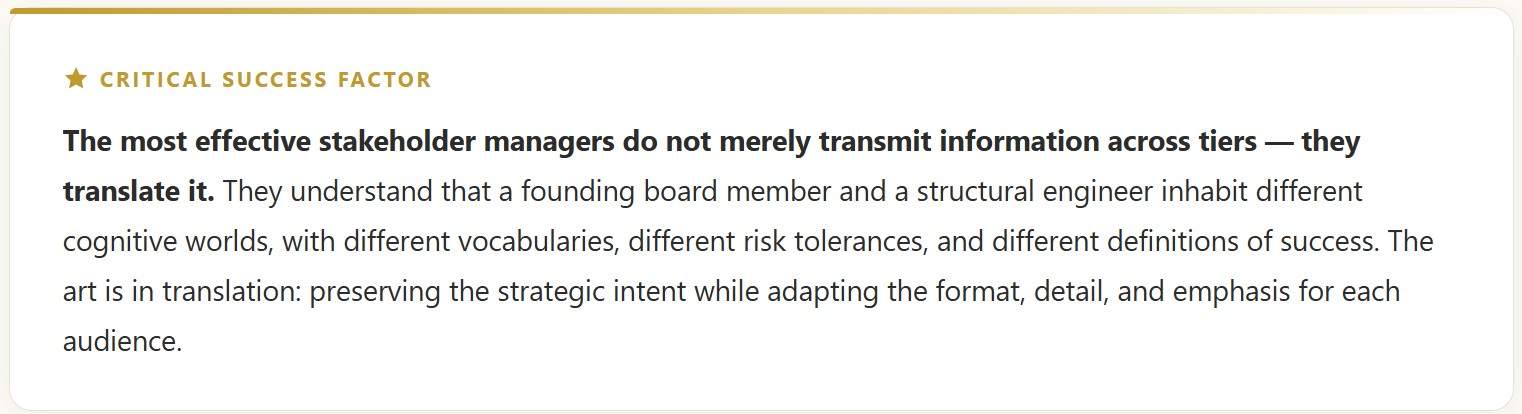
Bespoke Communication. One message does not serve all stakeholders. The same design decision may need to be communicated as a strategic vision statement to a founding board, a cost-benefit analysis to an investment committee, a technical specification to a design consultant, and a community impact summary to local stakeholders. The content is the same; the framing is entirely different.
Timing and Frequency Calibration. Over-communication erodes attention. Under-communication breeds suspicion. Each tier has an optimal cadence — executive engagement is event-driven, programme reporting is cyclical, consultant coordination is continuous. Miscalibrating frequency is a common and costly error.
Managing Upward, Sideward, and Downward Simultaneously. The unique challenge of a Design Director or Development Director in a giga-project is that they manage in three directions at once. Upward to executive and royal tiers for strategic alignment, sideward to PMC leadership and peer directors for programme coordination, and downward to consultant teams for design execution. Each direction demands a different communication style, a different level of detail, and a different emotional register.
Section 05
Real-World Application at Scale
This framework is not theoretical. It has been developed and refined through direct application on one of the largest and most complex development programmes in the world — a giga-project encompassing 14 distinct anchor assets, each operating as a significant development in its own right, coordinated under a unified programme vision with national strategic significance.
Within this programme, the stakeholder ecosystem included:
Royal and executive decision-makers with direct authority over vision direction, strategic pivots, and programme-level approvals — requiring bespoke, high-touch engagement calibrated to individual communication preferences and political priorities
A founding board overseeing national investment priorities, requiring presentations that balanced architectural ambition with financial rigour and strategic coherence — direct founding board presentation experience
Programme directors managing delivery governance across multiple assets simultaneously, requiring structured reporting that maintained cross-asset visibility without losing asset-specific detail
40+ international consultant teams spanning architecture, engineering, landscape, interiors, and specialist disciplines — each needing creative direction, technical coordination, and alignment to a design narrative they did not originate
PMC organisations acting as client representatives, requiring coordination that respected their governance role while maintaining design quality and strategic intent
End-user communities and operational stakeholders whose needs would ultimately define the success or failure of the built environment, requiring engagement that translated architectural vision into operational reality
Managing this ecosystem was not a matter of applying a textbook framework. It required daily calibration: reading the political dynamics of each tier, adjusting communication frequency in response to programme pressures, anticipating conflicts before they escalated, and maintaining strategic coherence across an environment where dozens of teams were making thousands of design decisions simultaneously.
The result was a stakeholder management capability that operated not as a support function but as a core leadership competency — the mechanism through which the founding vision was preserved and translated into built reality across every tier of the decision-making hierarchy.
"The quality of any collaborative endeavour is determined by the quality of the relationships within it. In the end, the building reflects not just the architect's vision, but the calibre of the conversation that produced it."
— Norman Foster
Conclusion
Stakeholder Navigation as Executive Competency
Over 27 years of practice — from early-career design coordination through to senior leadership on nationally significant giga-projects — one lesson has remained constant: the most important drawings a Design Director produces are not architectural. They are the invisible lines of communication, trust, and strategic alignment that connect every tier of the stakeholder ecosystem.
In the GCC's current development landscape, where Vision 2030, Expo 2030, and a generation of transformative programmes are moving from vision to delivery, the demand for professionals who can navigate multi-tier client ecosystems is acute. This is not a competency that can be acquired through training courses or methodology manuals. It is developed through direct experience at every tier — from royal decision-makers to operational delivery teams — and refined through the repeated practice of translating vision into execution across organisational, cultural, and political boundaries.
The stakeholder matrix framework presented here is the codification of that experience. It is a tool — but like all tools, its value lies entirely in the skill and judgement of the person applying it. For Development Directors, Programme Directors, and senior leadership navigating the complexity of giga-project delivery, stakeholder management is not a line item on a competency framework. It is the competency — the one that determines whether everything else succeeds or fails.